The “Nongque” volunteer UAV fire brigade: turning crop-spraying drones into forest firefighting capacity
Helped Wucheng District in Jinhua form a UAV fire brigade of 23 farmer pilots: the firefighting bucket carries 70-80 L per drop with a 90% hit rate, and the team went into action during the 2025 Jianfengshan fire.
Wucheng District covers 616,000 ha of forest, the government bought 28 UAVs of several types, and 23 farmer pilots formed the “Nongque” volunteer fire brigade — They spray crops on ordinary days and fly as a formation when fire breaks out. The take-off points and equipment stores sit halfway up the mountain above 900 m, so between the fire report and the first bucket on the ground there is no time to wait for ground equipment to climb up.
Why convert crop-spraying drones
When a county-level authority builds aerial firefighting capacity, the binding constraint is not technology but people and the number of aircraft already at hand. Crop spraying happens locally all year round, so the aircraft, the pilots and the maintenance capability are already there; swap the payload for a firefighting bucket and an existing team becomes firefighting capacity — No new batch of full-time pilots has to be trained.
The trade-off is that the payload has to fit the aircraft: the bucket must swap quickly onto different crop-sprayers without structural changes or a dedicated mount, and one person must be able to lift it on the ground. Our collapsible bucket body was built on exactly that premise.
What the team carries
- Main payload: smart firefighting bucket, 70-80 L per drop
- Drop hit rate: 90% (Measured on site)
- Team size: 28 UAVs / 23 certified farmer pilots
- Area covered: 616,000 ha of forest, take-off points above 900 m
Proven in the field
The model went into action during the 2025 Jianfengshan fire and was reported by the official media of the Ministry of Emergency Management and by China Emergency Management News, becoming a reference for county-level UAV firefighting brigades.
Operationally the value is not single-aircraft performance but turning a county's aerial firefighting capacity from nothing into something that can be called at any time — the first few tens of minutes of a fire are usually the whole response window.
How a day of work is scheduled
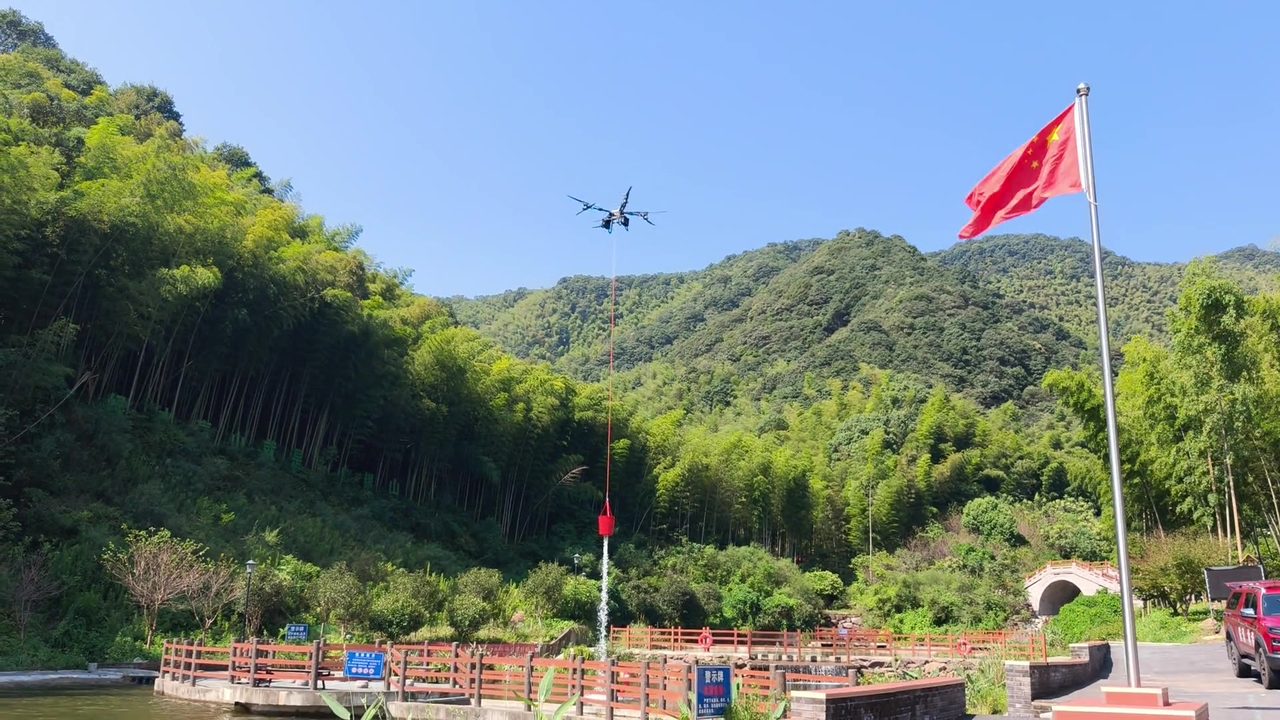
The formation runs a fixed rhythm of intake point, fire line, return: the bucket takes on water at the surface, drops on a fixed point above the fire, and picks up the next bucket on return. One aircraft detects and rotates up to 5 buckets automatically; swapping on the ground needs no re-trimming, which takes a stretch of ground preparation out of every round trip.
- Bucket capacity runs from 40 L to 200 L, chosen to match aircraft payload and intake conditions
- Valve linear from 0–100% with ≤ 0.6 s response, so drops can be stepped to match the fire
- IP68 rated throughout: the whole bucket can enter the water, so no fixed pumping station is needed
- Compatible with FC200 / FC100 / FC30 and more, so one team can fly a mixed fleet