
“Emergency Mission 2026” supertall fire drill: integrated air-and-ground firefighting at a 36-storey building
The drill simulated a fire in a 36-storey supertall building; we supplied firefighting buckets, water cannons and dry powder canisters for the formation's water drops and hover suppression, with fire-ground data returning to the command post in real time. Observed on site at ministry, provincial, municipal and district levels.
The drill simulated a fire in a 36-storey supertall building, with manned and unmanned formations working together and ground equipment in action at the same time. We supplied three kinds of firefighting payload — buckets, airborne water cannons and dry powder canisters — supporting the formation's water drops and hover suppression tasks.
Why supertall buildings need airborne capacity
Supertall fires come down to two problems: the working face above the fire floor, which ground aerial equipment cannot reach, and reignition points on the facade and at windows, which need sustained, precise cooling rather than one big drop. A UAV formation covers both gaps.
How the payloads were split in this drill
- Firefighting bucket: large-volume drops to suppress the fire and cool it down
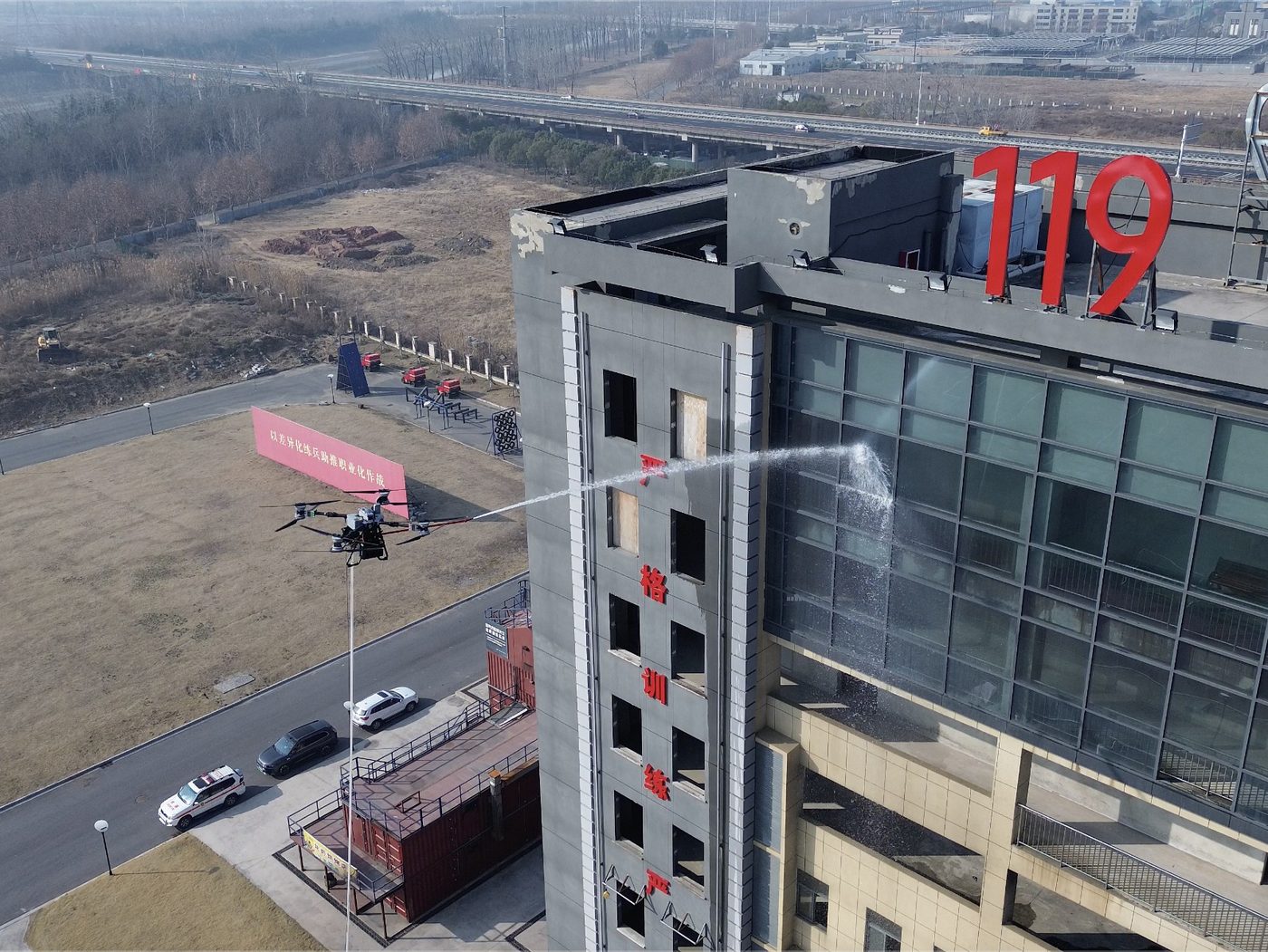
- Airborne water cannon: closes in on specific fire points such as windows and balconies for sustained spray
- Dry powder canisters: for electrical and specific-material fires
- Data link: pressure and position at the fire return to the command post in real time
How air and ground work together
The key to air-ground coordination is not that drones are in the air but the route allocation and payload mix decided in planning: which aircraft drop water, which hover and spray, and who works the windward face. These are set before take-off, with only fine trimming in flight.
Through the data link the command post sees pressure and position rather than video — This lets the commander judge from data whether the job is done, unaffected by smoke or light.
What the drill means for the product
What a drill exposes is usually not the flying but how payloads and procedures fit together: how long the bucket needs to hover to take on water, whether the cannon can hold station at a window, and how the canister drop is timed with the ground crew inside. These questions can only be answered on real buildings at real heights, which is why we treat drills like this as product validation milestones rather than publicity.
- Airborne water cannon: effective range ≥ 35 m, interchangeable 15 / 20 / 25 mm nozzles, universal spray-angle adjustment
- Hose 30 m × 3 reels, pressure rating 2.5 MPa (burst 3.2 MPa), spray gun 1.6 kg
- Firefighting water tank system: 75 L per flight, flow ≥ 60 L/min, spray distance ≥ 20 m
- Dry powder canisters cover electrical and specific-material fires and are dropped separately from the water runs
Scale of the drill
- Simulated 36-storey building
- Ministry, provincial, municipal and district leaders observed on site
- Three payloads deployed: buckets / water cannons / dry powder canisters